The Cat Mom’s Guide to Why Your Cat Knocks Things Off Tables
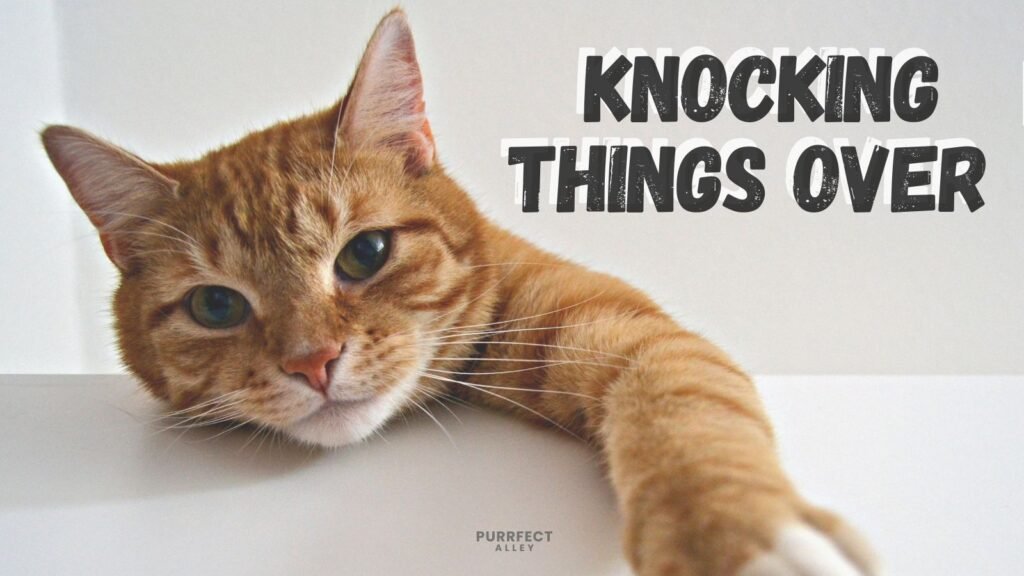
Why Does Your Cat Knock Things Off Tables? The Honest Truth From a Fellow Cat Mom
Let me paint you a picture.
It’s 8:00 AM. You’re on your third cup of coffee, trying to get through your morning emails. You look up just in time to see your cat—let’s call her Luna—make direct eye contact with you. She slowly extends one perfect little paw, taps your phone, and sends it flying off the kitchen counter.
Thump.
She doesn’t flinch. She just sits there, tail flicking, as if to say, “Yes, I meant that. What are you going to do about it?”
If this scene feels painfully familiar, welcome to the club. I’ve been a cat mom for over a decade, and I’ve lost count of how many pens, glasses, and yes, even a half-eaten sandwich I’ve had to pick up off the floor. But here’s the thing I’ve learned: our cats aren’t trying to be difficult (well, maybe a little). There’s actually some fascinating feline logic behind this behavior.
Today, I want to walk you through the four real reasons why our furry friends are so obsessed with testing gravity. More importantly, I’ll share what actually works to keep your belongings—and your sanity—intact.
The 4 Reasons Your Cat Is a Table-Tipping Pro

1. Curiosity and the Science Experiment
Cats are born scientists. I’m convinced of it.
Think about it: when your cat sees a new object on the counter, she doesn’t just see a pen or a set of keys. She sees an unknown variable in her environment, and she needs to investigate it.
Cats use their paws the way we use our hands. When they bat at something, they’re testing it out. They’re asking questions like:
- Does this move?
- Does it make a sound?
- Is it alive?
- Can I eat it?
- What happens if I push it?
It’s a full-on physics experiment every single time. They’re testing gravity, motion, and cause-and-effect. And honestly? If I had paws instead of hands, I’d probably do the same thing. The problem is, our stuff isn’t always designed to survive a feline science lab.
I’ve noticed my cat is especially drawn to things that are lightweight and easy to move. Pens, coasters, and loose change are her favorite test subjects. It’s not personal—it’s just science.
What I do about it: I’ve learned to ask myself, “Would this be fun for a cat to knock over?” before I leave anything on the table. If the answer is yes, I move it. Prevention is honestly the easiest solution here.
2. Boredom and the Need for Entertainment
Here’s a hard truth I had to accept: sometimes, my cat knocks things over because she’s bored out of her mind.
Cats need mental and physical stimulation every single day. When they don’t get enough of it, they create their own entertainment. And unfortunately for us, that entertainment often involves sending our belongings to the floor.
I realized this after a particularly long workweek. I had been so busy that I didn’t make time for our usual play sessions. By Friday, my cat had knocked over everything on my desk—pens, sticky notes, even a small plant (RIP, little succulent). It wasn’t malice. It was a cry for help. A “Hey, Mom, I’m bored over here!” message delivered in the most chaotic way possible.
When cats are under-stimulated, they look for anything that might be interesting. A pen that rolls when pushed? Interesting. A glass that makes a satisfying clink? Interesting. Your keys that jingle? Very interesting.
What I do about it: I prioritize daily playtime. It doesn’t have to be long—15 minutes with a wand toy makes a huge difference. I also rotate her toys so she doesn’t get bored of the same ones. And I’ll be honest, sometimes I just give her a cardboard box. She’s happy, and my coffee table stays safe.
3. The Hunting Instinct in Action
This one was a game-changer for me to understand.
In the wild, cats are hunters. They stalk, they pounce, and they bat at their prey to test if it’s alive and safe to catch. That instinct is still very much alive in our domesticated little furballs.
When your cat knocks something off the table, she’s tapping into that primal hunting behavior. She’s checking to see if that object is “prey” worth chasing. When it moves—especially if it rolls or bounces—it triggers her chase instinct. Suddenly, your hair tie isn’t just a hair tie. It’s a small animal that needs to be caught.
This is why cats are so obsessed with things that move easily. Pens roll, bottle caps skitter, and small toys bounce. It’s not about destroying your stuff. It’s about satisfying a deep, instinctual need.
I’ve noticed that my cat is most likely to knock things over right after she’s been sleeping all day. It’s like she wakes up, realizes she hasn’t hunted anything in hours, and decides my office supplies are the closest thing to prey.
What I do about it: Instead of fighting the instinct, I work with it. I redirect her hunting energy toward toys that are actually meant for chasing. I have a stash of crinkle balls, toy mice, and feather wands that give her an appropriate outlet. When she’s in a “hunting” mood, I grab a wand toy and let her go to town. Twenty minutes of chasing and pouncing, and she’s ready for a nap—leaving my pens alone.
4. A Clever Grab for Attention
Let’s be real for a second. Our cats are smarter than they let on.
They know exactly how to get a reaction out of us. And what gets a faster reaction than a loud crash followed by us running into the room?
I hate to admit it, but I’ve been trained by my cat. She knows that if she knocks something over, I’ll come running. Even if I’m annoyed, I’m still giving her my full attention. And for a cat, any attention is good attention.
This is especially true if you’re busy and your cat is feeling ignored. Maybe you’re on a work call, cooking dinner, or scrolling through your phone. Your cat knocks something over, and suddenly, you’re completely focused on her. Mission accomplished.
I noticed this pattern when I started working from home more often. My cat seemed to have a sixth sense for when I was in a meeting or on a deadline. She’d wait until I was completely absorbed in something, and then—crash. She had me right where she wanted me.
What I do about it: This is the hardest tip to follow, but it works: I try not to react.
It takes every ounce of self-control I have, but I’ve learned to stay calm. I don’t yell, I don’t run over, and I don’t give her any dramatic energy. If it’s safe to leave the item on the floor for a minute, I do. I pick it up later, when she’s not looking, and I redirect her to something more appropriate.
When she does interact with her toys nicely, I make a big deal out of it. Positive reinforcement goes a long way. She’s slowly learning that playtime happens with her toys, not with my coffee mug.
What Actually Works: Actionable Tips From One Cat Mom to Another
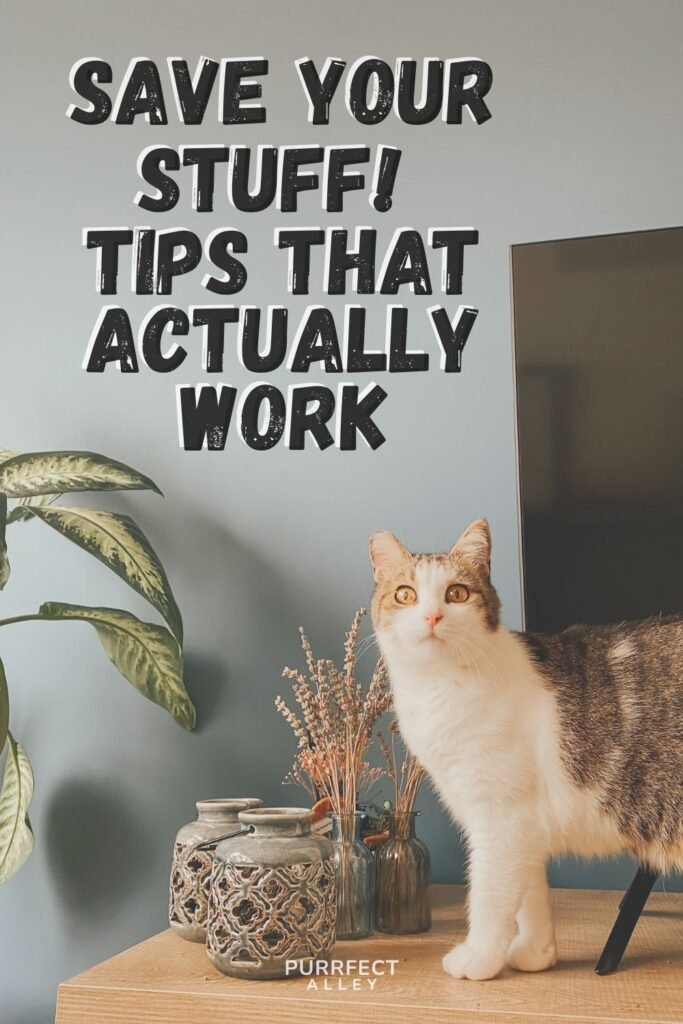
Understanding the “why” is half the battle. The other half is figuring out what to do about it. Here are the strategies that have genuinely helped me save my stuff (and my sanity).
Clear the Decks (Literally)
I know this sounds obvious, but it’s the most effective thing I’ve ever done. I stopped leaving small, knockable objects on the edges of tables and counters. If it can fall, it will fall.
I keep my phone, keys, and glasses in a drawer or a closed container. My pens live in a mug that’s too heavy for my cat to tip over. And I never, ever leave a full glass of water on the nightstand anymore. I learned that lesson the hard way—at 2 AM.
Think of your flat surfaces as a stage for your cat’s performances. The fewer props, the less dramatic the show.
Create a Cat-Friendly Kingdom
Cats thrive when they have their own spaces. I’ve invested in a few cat trees and window perches, and it’s made a world of difference. When my cat has high places to climb and observe, she’s less interested in my coffee table.
I also make sure she has plenty of toys that she can bat around to her heart’s content. Crinkle balls, jingly mice, and pompoms are her favorites. I scatter them around the house so she always has something to do.
If you’re dealing with a high-energy cat, you might want to try some enrichment activities. Puzzle feeders, treat-dispensing toys, and interactive games can tire out their brains in the best way. I’ve written about some of my favorite calming and enrichment products in our roundup—they’re worth checking out if your cat seems restless.
Master the Art of Non-Reaction
I’ll be honest: this one is still a work in progress for me. But I’ve gotten so much better at it.
When my cat knocks something over, I take a deep breath. I don’t look at her. I don’t say anything. I calmly finish whatever I was doing, and then I pick up the item when she’s not paying attention.
It sounds silly, but it really does work. When she realizes that knocking things over doesn’t get my attention, she stops doing it as much. It takes patience, but it’s worth it.
Play With Your Cat Every Day
This is non-negotiable in our house. I set aside at least 15 minutes a day for interactive playtime. I use a wand toy and mimic the movement of prey—quick, jerky motions, hiding behind furniture, letting her pounce.
It’s amazing how much calmer she is after a good play session. She’s more content, more relaxed, and way less likely to send my belongings flying. A tired cat is a happy cat, and a happy cat doesn’t need to create chaos.
If you’re not sure where to start, try a feather wand or a laser pointer (just make sure to let them “catch” something at the end so they don’t get frustrated). Every cat is different, so experiment and see what your kitty loves.
You Are Not Alone in This
I need you to hear this: your cat isn’t trying to make your life difficult. She’s just being a cat. And honestly? That’s part of what we signed up for.
Being a cat mom means embracing the chaos a little bit. It means laughing when your cat sends a pen flying across the room. It means understanding that sometimes, they just want your attention in the loudest way possible.
I’ve been there. I’ve picked up broken mugs, rescued plants from the floor, and fished keys out from under the couch more times than I can count. And every single time, I look at my cat, and she just stares back at me with those big, innocent eyes.
She knows what she did. And she knows I’ll love her anyway.
Frequently Asked Questions (FAQ)
Nighttime is prime hunting time for cats. Their natural instincts are most active at dawn and dusk, so you might notice more knocking behavior during those hours. They’re also bored and looking for entertainment while you’re sleeping. Consider a late-night play session to tire them out before bed, or leave some engaging toys out for solo play.
Usually not! Knocking things over is rarely a sign of aggression. It’s more often about curiosity, boredom, or seeking attention. If your cat seems otherwise friendly and relaxed, this is just a normal feline behavior—even if it is a little frustrating for us humans.
Probably not, but you can manage the behavior. Cats of all ages knock things over, though kittens and young adults tend to do it more often due to their higher energy levels and curiosity. The key is providing enough stimulation and making sure your valuable or breakable items are out of reach.
Safety comes first. If your cat knocks over something that could hurt her—like a glass that shattered or a candle—stay calm and carefully clean it up. Make sure all glass shards are swept up and the area is safe. Then, redirect your cat to a toy or a puzzle so she doesn’t go near the danger zone again.
Boredom often comes with other signs: excessive meowing, destructive behavior, over-grooming, or sleeping more than usual. If your cat seems restless and you haven’t played with her much that day, it’s probably boredom. Curiosity-driven knocking usually happens when there’s a new object or something that caught her eye. Either way, extra playtime and enrichment are the best solutions.
Final Thoughts From This Cat Mom to You
At the end of the day, our cats are who they are. They’re curious, instinct-driven, and sometimes a little chaotic. And honestly? That’s why we love them.
The next time your cat sends your phone flying off the counter, take a breath. Try to see it from her perspective. She’s just doing what cats do. And with a little understanding and a few simple changes, you can keep your home (mostly) intact while keeping your feline friend happy and stimulated.
You’ve got this, cat mom. We’re all in this together—one fallen pen at a time.
Have your own tips for managing your cat’s table-knocking habit? I’d love to hear them. Drop a comment below and let’s support each other through the chaos!
-
The Cat Mom’s Guide to Why Your Cat Knocks Things Off Tables
If you’ve ever watched your cat send your favorite mug flying, you’re not alone. This guide breaks down the 4 real reasons behind this classic cat behavior—curiosity, boredom, instinct, and yes, a little chaos. Plus, get practical tips from one cat mom to another on how to manage the mayhem and keep your home (mostly)…